
Rusty Santos and the Quiet Art of Collaboration
Interview conducted by Charles Xu and Hannah Usaha, edited by Ruby Greenstone.
Rusty Santos, a musical polymath, has spent the past two decades moving fluidly between scenes, formats, and musical languages, often operating just outside the spotlight while leaving a deep imprint on the records and artists he touches. A producer, engineer, and solo artist, his work has traced a wide arc – from experimental pop and acoustic minimalism to underground dance music.
That openness has led him into collaborations across unlikely worlds, including work alongside figures as disparate as dance legend DJ Rashad and avant-garde provocateur Momus, as well as long-standing partnerships within experimental pop’s inner circles such as Animal Collective. Rather than anchoring himself to a single scene, Santos has consistently embedded himself in communities, learning their internal logic before translating it into his own practice.
Under his own name, Santos releases solo material rooted in acoustic instrumentation, sampling, and long-form songwriting, extending the same exploratory impulse that defines his collaborative work.
Ahead of the release of his forthcoming album Psycho Horses, Rusty Santos joins FASE for an in-depth conversation on his work as a producer, collaborator, and solo artist.
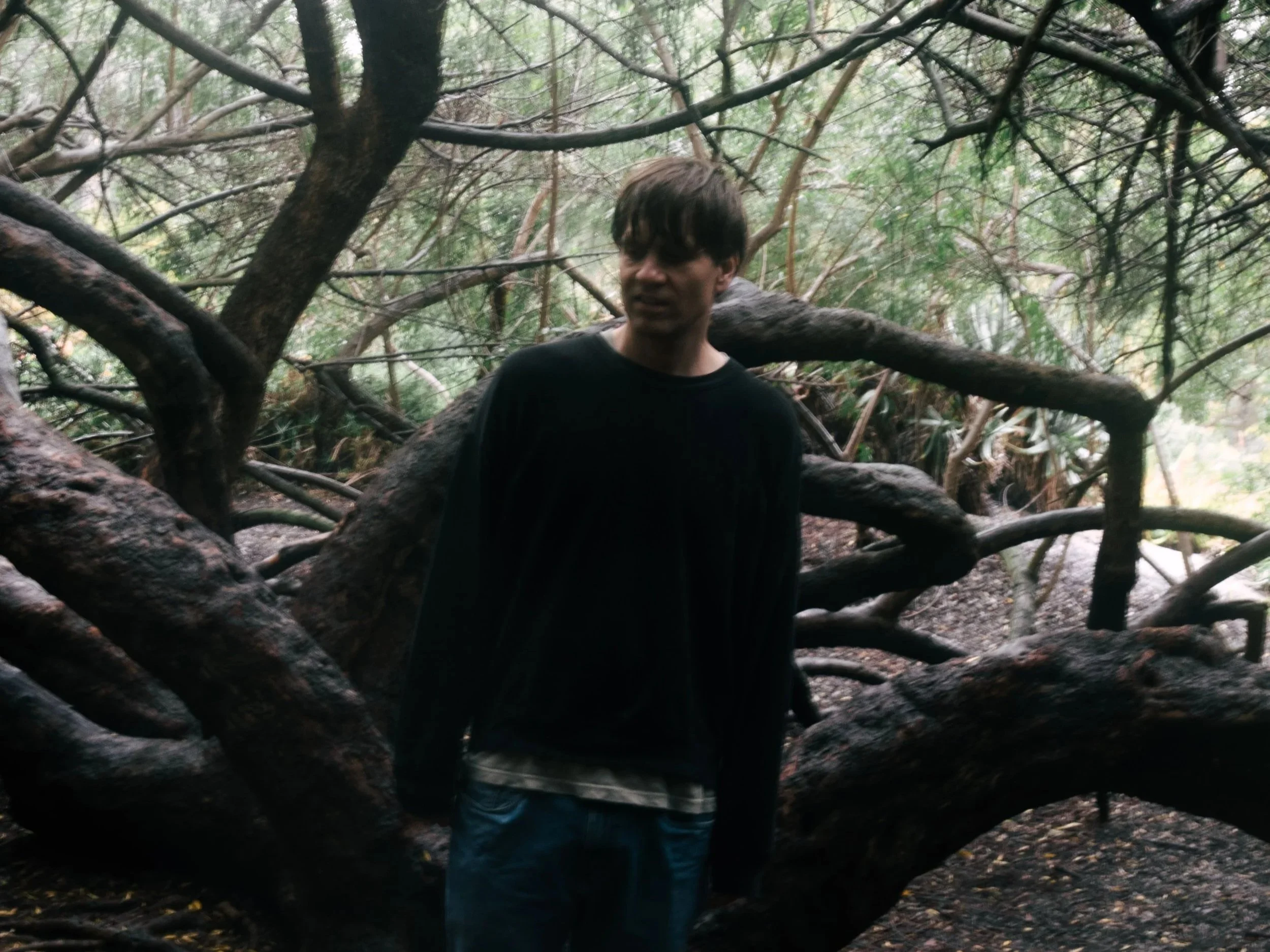
Photo by Charles Xu.
Q: Growing up in Fresno, spending time in countries such as Germany and Japan, and later immersing yourself in New York’s experimental scene, what are some formative experiences that pushed you towards a career in music production?
A: I’m from Fresno, but I lived in Nagoya, Japan, until around the age of eight, and I was in an international school. My parents were ESL teachers, and while in Japan, I was asked to do a spoken word on this band Lushel’s album. It was me and my sister; they wanted some American kids to speak. This is in the 1980s, and they were kind of like a hair metal group. That was my first time in a recording studio, and I just couldn’t believe that the person that was singing in the booth was gonna end up on a record; ‘cause to me, these records were like discs of fantasy, like David Bowie and Michael Jackson were the only records that I had. And so, it was being in the recording studio with Lushel that inspired that. I was on their song “Utopia.” If you look that up, you’ll hear that a kid is talking at the top of the song, and that’s my voice. That was the first record I was on, back in the eighties. Sounds like a long time ago.
Q: Your work spans everything from indie psychedelia to avant-pop. When you think back to your earliest musical aspirations, did you envision this broad spectrum of styles?
A: I was always interested in participating in scenes, and I was interested in how music happened. Because I knew it just didn’t happen because of instruments and machines and chords, and it actually involves people. It’s the relationship between people that invents music, and also when you do something that you’re not supposed to do with the machine or with the instrument.
And so I didn’t know what I wanted to do, but I also knew I didn’t want to do what we used to call mainstream music. I felt like it was really important to do something that was non-commercial in nature. After I moved to New York City, I started opening my mind to what I think was this post-Warhol scene, and that movement in art was really happening. I was like, “Oh, there can be a benefit in stuff that appeals to the masses.” It was actually working with Animal Collective that got me more into pop music.
Q: Your website mentions that you see production as a collaboration between you and the artist, capturing both “electrical and biological aspects to emphasize the human.” Are these words your response to something you feel is often lost in modern production?
A: I think that words like “producer” and “artist” are starting to lose their meaning when they are self-applied. I never decided to call myself either of those things. [On the website] I was talking about how humans interacting with each other created the types of music that I was interested in and how I wanted to learn. Those can be traced back to parts of our own biology, like the heartbeat, the time, how we experience, how our sense of hearing, perception of the world, and our sense of reality. So it’s the human making it that I’m collaborating with. It’s not necessarily a product, and certainly not a machine. Although we use them, and I think the machines have kind of grown to reflect that human side, too. So that’s why I’ve always been interested in the acoustic and the electronic, and where those two processes intersect.
Q: You’ve worked multiple times with Panda Bear of Animal Collective — from the band’s critically acclaimed Sung Tongs to recent collaborations like “Mirror.” How has your creative relationship evolved over the years?
A: I think I’ve always admired his talent more than anything. One of the things that inspired me when working with him was how much he affirmed what we were doing. There wasn’t much pushback – it was more like we’d find things that we both liked and focus on those. I don’t really recall, at least on projects we were actively working on, spending much time on things we didn’t like. I never really heard much about things we didn’t like, because if there was something that didn’t resonate, it simply didn’t get emphasized. It wasn’t going to end up on the record. A good example from Buoys would be the first song, “Dolphin.” One of the last things added was a hi-hat, and I think I initially had a hi-hat in there just as a placeholder. Then, halfway through the song, a delay comes in, and it goes from eighth notes to sixteenth notes. I remember thinking, “That’s so much hi-hat—way too much hi-hat.” But he was fine with it. For a long time, that’s all I could hear in the song. Eventually, though, I realized that it was actually doing exactly what it was supposed to do. That way he trusts his own first response taught me a lot.
In a broader sense, that speaks to the effect he’s had on my own musical evolution. As our relationship developed, there was a real willingness on both sides to move into new directions. Part of that came from my own exploration of other styles of music: I started working a lot in what you might call left-field club music, particularly kuduro and funaná, these African dance genres. He was open to what was happening there, especially in how we thought about material rhythmically. I was also really fascinated, around the time we made Buoys, by rap beats in production, because I noticed that in rap music, you have to have that collaboration of a scene of people. It’s not like something you just make, even though it’s so mechanical, it actually does come from a culture of how that music is made. He was interested in those things, but at the same time, he helped bring me back to my roots. When I was going very far into global sounds and different genres, he kept me grounded in where it all started, which I think is that electroacoustic sound.
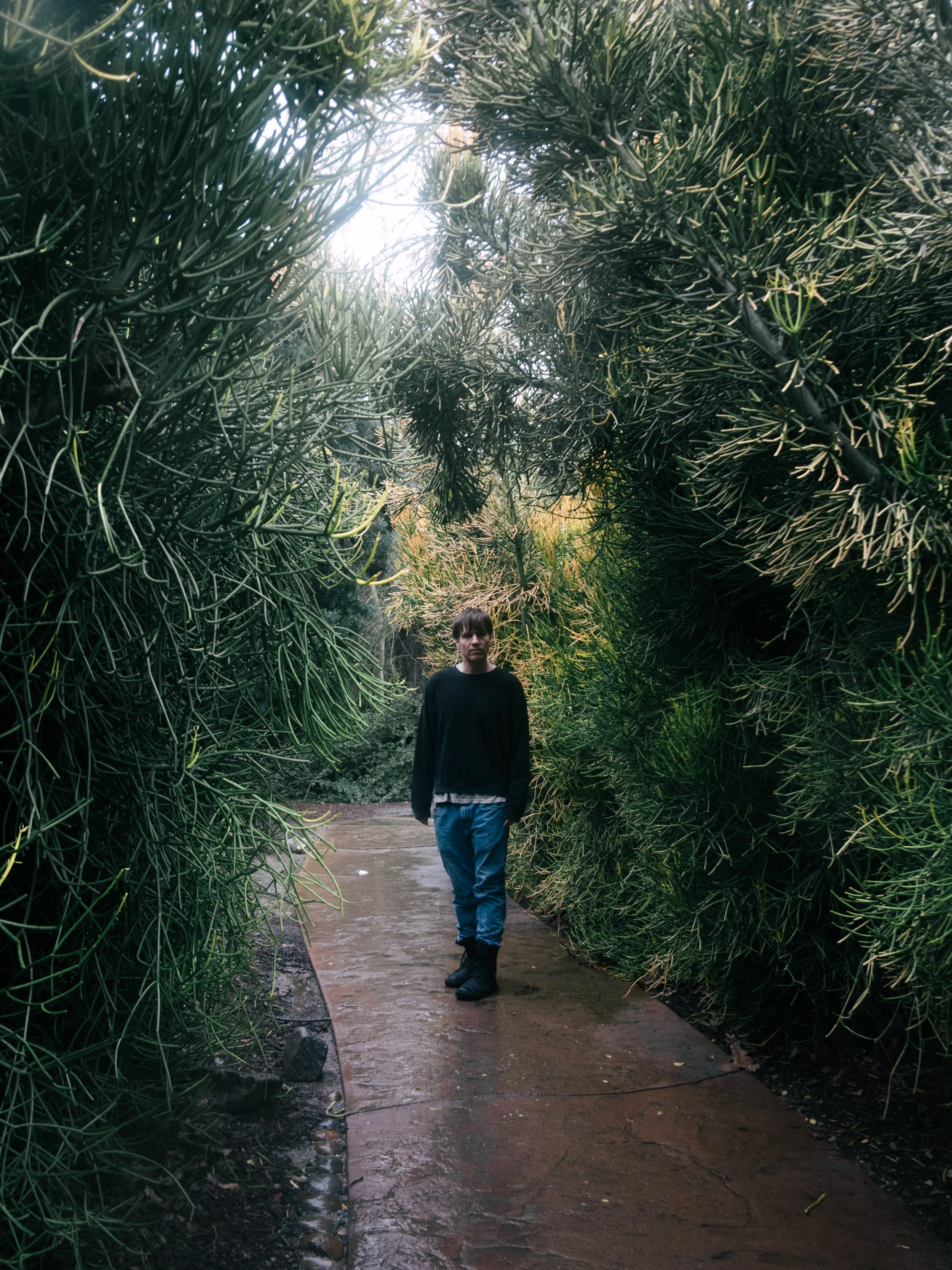
Photo by Charles Xu.
Q: When collaborating with an artist, when do you feel like you need to assert your vision, and when do you step back and let your collaborator take control?
A: I feel like I will present my vision, and it will either be accepted or another path will be taken. But I don’t feel the need to assert my vision.
Q: You’ve worked across acoustic instruments, samplers, modular electronics, and digital production. How has evolving technology reshaped your role as a producer?
A: Samplers are very important. Modular electronics – definitely – Panda Bear has been utilizing those, and I’ve worked with other people in studios who do as well. For me, though, I tend to think about modularity more in terms of components rather than a modular synth specifically. Almost anything can be modular, especially in an acoustic environment – how you partition a room, how you capture different sounds in a space, and how performers respond to those environments in real time.
Sampling has been fundamental, especially as we moved away from tape recording and into computer-based recording. A computer is essentially a sampler, so there’s no digital recording that isn’t sample-based. The real question is how you interact with those samples. Are they mapped across a sequencer that mirrors a tape machine, or are they segmented into individual sounds on pads, like an MPC? I learned a lot about using samples as instruments from DJ Rashad when I was working with him on Teklife and Traxman. That approach was very different from Panda Bear’s, who often used samples more as source material and then manipulated them within a sampler. To me, those feel like opposite approaches. Through that contrast, I found my own path, which leans much more toward collage-based sampling. And I think the albums I’ve made that reflect this most clearly are the first two The Present records we released on Lo Recordings: World I See and The Way We Are. For those, I sampled live improvisations and then built compositions from them – some pieces spanning three minutes, others half an hour. They’re sample-based and acoustic at the same time, with live, interactive performances between musicians all existing within the same composition or across the album.
Q: Can you talk a bit about how you balance experimentation with musical accessibility for the masses? Have there been moments when you deliberately allow the “weirdness” to dominate?
A: I like that question, because I feel like in the canon of experimental music, of musique concrète, and other genres that get taken very seriously in a more academic or art world context, experimentation is presented in a very cerebral fashion. My roots come from a much more workaday process, where we have to make music that serves a function. Most of the time, it just has to entertain people enough that they listen, and so that we can have enough of an audience to justify the expense that we’re putting into it; I also am dependent on it for my own livelihood.
So not having the benefit of those institutions – the entertainment aspect of experimentation – is part of the foundation of the craft. We’re still in the music business. I don’t like using the word “business,” but it’s the format. Just like there’s a format for any medium – whether it’s theater, art, or painting – the way we get this music out is through the business side of it. It’s just a very small business compared to what you might call the masses, or mass entertainment. But it doesn’t matter that it’s small; we still have to make it work. People still have to be moved by it. In that sense, experimentation becomes part of the entertainment and part of what makes people think.
Q: Do you ever find yourself shrouded by limitations (whether of gear, software, or time) that end up pushing a track in a better direction?
A: I find myself constantly limited by time and by other considerations. Limitations that involve talent, machines, or equipment, or instruments, are very constructive because they map out possibilities. A piano [for example] is a very limited instrument. If it had every note, it would be very difficult to create or to cover every possible frequency or note. But that it’s limited to these octaves and these scales creates limitations. The limitation of time is real, and the more you respect that, the better. The process is like that. “Time is not a limit” is an illusion. We are always short on, or we’re always – we’ll wait for the siren to go by.
*This interview took place under unplanned conditions. By the time we had departed from the photoshoot, we learned that our intended location for conducting this interview – a quiet café – had closed without advanced notice, leaving us with no clear alternative. After a short, waterlogged search, we gave up and settled outside a Starbucks in the pouring rain. Santos met the moment with an unhurried calm and patience, speaking eloquently with attentiveness and generosity despite the less-than-ideal circumstances. His presence, free of frustration or distraction, had eased the mood. In that way, the setting shaped the conversation as much as the questions did.
So, time is a limit that’s important to respect. But fear, which I see more expressed as anxiety, is something I don’t have much respect for. Oftentimes, it’s coming from a place of what other people will think, which is not something that you have control over. Anytime that rabbit hole gets explored, it ends up in a less potent space. Fear and anxiety are those things that water down production. So, when artists come to me with those concerns, that’s maybe the only time I ever lose patience. But part of what we do with artists is to work with that psychology. Because it’s real, and we all experience those things. Therefore, I find there is another type of limitation: “how far outside of a comfort zone can I help bring another one of my collaborators,” and I love it if they can bring me outside of my comfort zone as well.
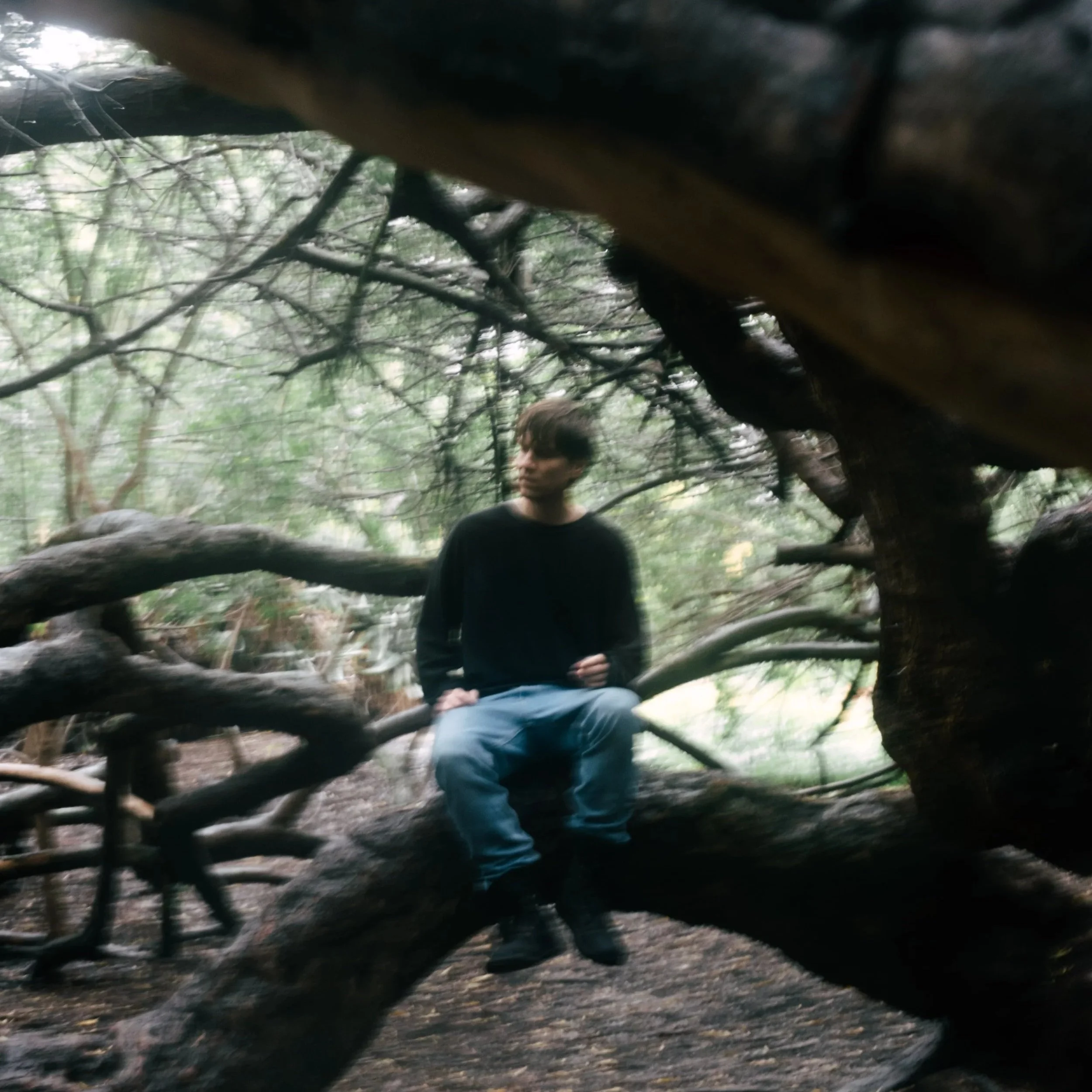
Photo by Charles Xu.
Q: How do you decide when a take is “done,” especially when working on music that is intentionally amorphous or experimental?
A: This has been something that I’ve improved on over time, and most of the time it’s done on the first complete expression [of] the idea, the emotion – whatever it is that you’re trying to express. Further exploration is usually a seeking of perfection, and that tends to be folly. There is no such thing as perfect, and the way an artist will respond to their own performance differs sometimes from the way the audience [does], so I’ve learned to accept the results as early in the process as possible.
Q: The acoustic guitar is a central and defining element in your solo work. How did that instrument become such a formative part of your musical identity, and do you feel a particular attachment to it compared to others?
A: For me, drums are the most important aspect. But I also feel like the tradition I most closely found roots in is something more like folk – something that could be passed on. The acoustic guitar, the way I see it, is a drum. It’s percussive. Even though it has tonality, it provides rhythmic support along with the chord structure and, sometimes, the melodic structure.
I think of acoustic guitars very much as drums with harmonic and frequency resonances. Just like you would tune a drum kit, you tune an acoustic guitar. So I place it more in the realm of percussion, which allows it to fully accompany a vocal. The vocal then serves the primary melodic function, strictly speaking, in terms of musical arrangement.
Although lyrics happen to be important to me, they’re not important to everyone I work with. That said, I do find that the symbolism involved with lyrics can be influential in how the music is experienced overall.
Q: Across your solo albums, your use of texture has become increasingly expansive. How has your approach to sound design and timbre evolved over time, and what has driven that evolution?
A: It’s hard to answer this without thinking about what I’m working on at this exact moment. Right now, I’m actually trying to isolate texture more and find ways of expressing it outside the direct context of music itself. Going back to the two albums I released on Lo Recordings, I was probably most successful in terms of texture on those records.
That said, with Sung Tongs, I feel like the style of engineering I chose was very important. I originally thought of it as a quadraphonic record, which is something I didn’t really talk about much, especially with the band. I used two pairs of stereo microphones and thought carefully about how those created texture. That approach started early in the process. I remember Avey Tare saying he wanted to make an acoustic My Bloody Valentine [record], and to me, My Bloody Valentine was always very textural.
So there’s this ebb and flow between synthesizer – or sometimes not synthesizer – and guitar, whether electric or acoustic. That’s something that runs throughout the records I’ve worked on, both in my own music and in other productions. But if I were to shorten my answer, it really comes down to the emotional textures of an album. The sonic textures you’re hearing are reflections of the emotional timbre.
Q: You’ve described your forthcoming album Psycho Horses as “your antidote to sleepwalking,” with songs written in dreams and recorded awake — can you talk about how that process shaped the mood and themes of the album?
A: I think that not all of the record, but a high percentage of it, I wrote while inside of dreams. I had kept a phone like we all have nearby, and so I would wake up and then I would sing the lyrics and the melody into my phone and I would fall back asleep. The next day in the studio, I would work that in as the top vocals on whatever the instrumental, so the songs, and then the missing parts of the song I would make to complete the process that came to me in a dream. It was coming from a part of myself that was more intentful. You might say subconscious, but I think it was just a more urgent part of my inner life. When I say “antidote to sleepwalking,” it just means that even when so many people are awake – in the sense that we’re workaday, waking life, sometimes we’re not fully aware of ourselves.
This record was a reminder, at least to myself, and maybe to a few other people as well, that being awake to your circumstances, to being alive, to life itself, isn’t automatic. It’s something you earn; it’s a decision you make to maintain a state of wakefulness. And I do feel that, in many ways, sleepwalking is an accurate diagnosis of much of the course of this world, of humanity – even people who think they’re awake are often still asleep.
Q: Listening to Psycho Horses, it feels like a deeply personal body of work. In what ways has your life, up until this point, shaped how you chose to present yourself on this album?
A: I’ve got a lot of experiences. I’m fortunate to have had as many experiences as I had, and that’s one thing on that paragraph where I talk about how I traveled with the circus, wore many hats in music. I felt like this is an album made from the perspective of someone who isn’t necessarily wisened, but someone who has lived and experienced things – and that there’s a reason for this person, and this music, to exist as a result of those experiences. I think that’s also why I connect it to the folk music tradition. A lot of folk music comes from personal experience, from an emotional need to relate and document those experiences so they have meaning, so they don’t just disappear. Like – I’ll borrow from Blade Runner – “All those moments will be lost in time like tears in rain.”
Q: Is there a misconception people have about musicians that you wish more listeners understood?
A: I feel like musicians don’t enjoy the best reputation socially. [The] people who play music know how much it takes, [and] how much of yourself goes into it. I think one misconception might be that there’s a choice involved. Like, when you’re fully in the grips of having to make music, it’s not so much of a choice. It’s who you are. Maybe there’ll be a time in the future where we say, “this person is a musician and that’s who they are.” I feel like with me at least – and I think every musician I know is like this – it’s who you are. And so when people kind of say, “why don’t they just, you know, make these other choices?” Well, it’s like you have to navigate your life in such a way that you can be a musician and still do these things that are required of you in life.
Q: Are there emerging artists or scenes you feel excited about right now?
A: I mean, there are always artists and scenes that I feel excited about. It’s just that I’m in a period of focusing on finishing some ideas that I need to express, and so I’m slightly less inclined to go venture out. That said, I am working with a lot of artists in L.A. at the moment, people I’ve met through the local scene – Harry the Nightgown, Texturas, Groceries!, and Photay.
There have been other periods in my life when I really dove deeply into specific scenes. When I got into Latin music, I moved to Mexico City and joined a crew of reggaeton and trap-triste artists, and I immersed myself fully in that world. The same happened when I became involved with what I hesitate to broadly call African music, because that’s really too general. More specifically, I was working with kuduro, zouk bass, and funaná, along with a strong influence from the kizomba scene. It was perhaps somewhat Durban-adjacent, but even that represents only a tiny fraction of what African music encompasses. There’s so much other incredible music from Africa that I love, like guitar music from Mali, for instance, which I wasn’t directly involved with, or pop coming out of Somalia and Nigeria.
The genres I worked in most closely were the ones I mentioned, and I traveled to Cape Verde and spent a lot of time around the diaspora while living in Lisbon, Portugal, to really learn about those styles. Later, when I moved to L.A., it was similar with the rap scene. I was working with a lot of people involved in that exchange between Los Angeles and Atlanta, spending time in those studios because I wanted to understand how those songs were made.
At the moment, once I finish developing the ideas I’m working on, I might find myself diving into something new like that again. Or, honestly, an even better example than the ones I’ve mentioned is when I first heard footwork and met DJ Rashad. Almost immediately, I was in Chicago, going to Battlegrounds and watching the dancers. One of the things Rashad taught me – and this ties back to what I was saying earlier about function – is how dance music is learned and understood through its purpose. With footwork, the music is for the dancer first; everything else comes after that function.
With experimental music, I think the function is different. It’s about seeing the world in new ways, about gaining a deeper understanding of what reality actually is. That’s the function I’m currently trying to reconcile with my own work.
Rusty Santos’ upcoming album Psycho Horses is due for release on February 19th, 2026, and will be available on streaming, CD, and vinyl.
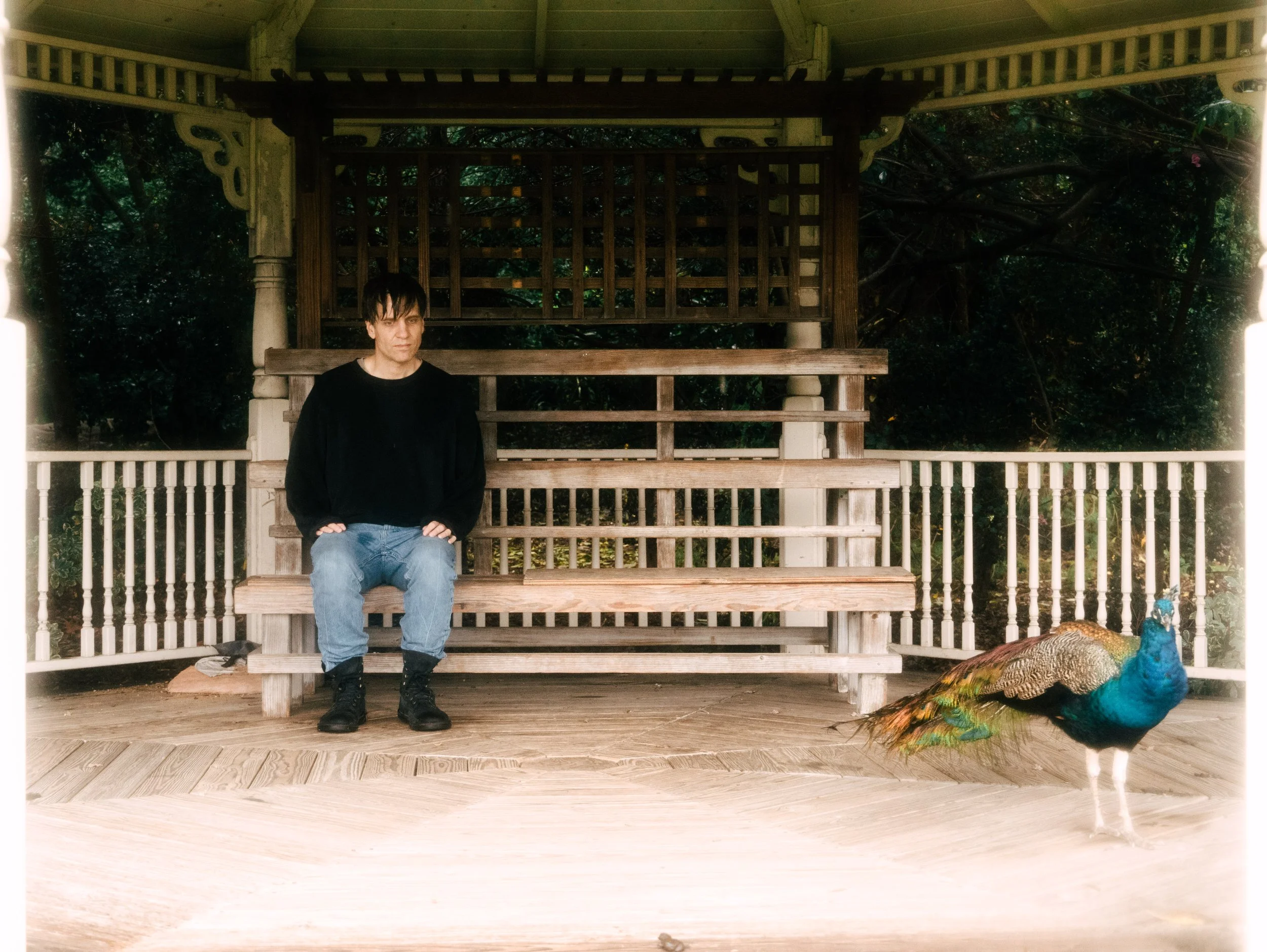
Photo by optical♱vein.
